
Etymology & Usage-
The term "Casino" is of Italian origin, the root word being "Casa" (house) and originally meant a small country villa,summerhouse or pavilion. The word changed to refer to a building built for pleasure, usually on the grounds of a largerItalian villa or palazzo. Such buildings were used to host civic town functions – including dancing, music listening, and gambling.
There are examples of such casinos at Villa Giulia and Villa Farnese. In modern day Italian, this term designates a bordello(also called "casa chiusa", literally "closed house"), while the gambling house is spelled casinò with an accent.
During the 19th century, the term "casino" came to include other public buildings where pleasurable activities, including gambling, and sports took place. An example of this type of building is the Newport Casino in Newport, Rhode Island.
Not all casinos were used for gaming. The Copenhagen Casino was a theatre, known for the use made of its hall for mass public meetings during the 1848 Revolution which made Denmark a constitutional monarchy. Until 1937 it was a well-known Danish theatre. The Hanko Casino located in Hanko, Finland - one of that town's most conspicuous landmarks - was never used for gambling. Rather, it was a banquet hall for the Russian nobility which frequented this spa resort in the late 19th century, and is presently used as a restaurant. The Catalina Casino, a famous landmark overlooking Avalon Harbor onSanta Catalina Island, California, has never been used for traditional games of chance, which were already outlawed in California by the time it was built.
In military and non-military usage in Spanish and German, a casino or kasino is an officers' mess; curiously, in Italian - the source-language of the word - a "casino" is either a brothel, a mess, or a noisy environment, while a gaming house is called a "casinò". A confusing linguistic false friend for translators.

History of gambling house-
The precise origin of gambling is unknown. It is generally believed that gambling in some form or another has been seen in almost every society in history. From the Ancient Greeks and Romans to Napoleon's France and Elizabethan England, much of history is filled with stories of entertainment based on games of chance.
The first known European gambling house, not called a casino although meeting the modern definition, was the Ridotto, established in Venice, Italy in 1638 to provide controlled gambling during the carnival season. It was closed in 1770 as the city government perceived it to impoverish the local gentry.
In American history, early gambling establishments were known as saloons. The creation and importance of saloons was greatly influenced by four major cities; New Orleans, St. Louis, Chicago and San Francisco. It was in the saloons that travelers could find people to talk to, drink with, and often gamble with. During the early 20th century in America, gambling became outlawed and banned by state legislation and social reformers of the time. However, in 1931, gambling was legalized throughout the state of Nevada. America's first legalized casinos were set up in those places. In 1978 New Jersey allowed gambling in Atlantic City, now America's second largest gambling city.
Gambling in casinos-
Most jurisdictions worldwide limit gambling to persons over the age of license (16 to 21 years of age in most countries which permit the operation of casinos).
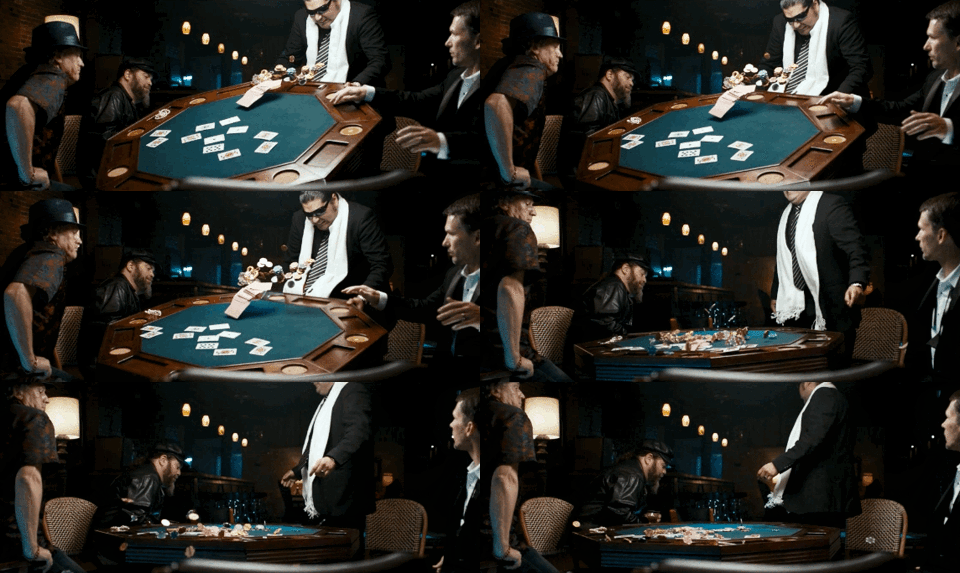
Customers gamble by playing games of chance, in some cases with an element of skill, such as craps, roulette, baccarat, blackjack, and video poker. Most games played have mathematically-determined odds that ensure the house has at all times an overall advantage over the players. This can be expressed more precisely by the notion of expected value, which is uniformly negative (from the player's perspective). This advantage is called the house edge. In games such as poker where players play against each other, the house takes a commission called the rake. Casinos sometimes give out complimentary items to gamblers.
Payout is the percentage of funds ("winnings") returned by players.
Casinos in the USA say that a player staking money won from the casino is playing with house money.
Video Lottery Machines (slot machines) have become one of the most popular form of gambling in casinos. As of 2011investigative reports have started calling into question whether the modern-day slot-machine is addictive.

Design-
Casino design - regarded as a psychological exercise - is an intricate process that involves optimising floor plan, décor and atmospherics to encourage consumer gambling.
Factors influencing consumer gambling tendencies include sound, odour and lighting. Natasha Dow Schüll, an anthropologist at the Massachusetts Institute of Technology, highlights the audio directors at Silicon Gaming’s decision to make its slot machines resonate in, “the universally pleasant tone of C, sampling existing casino soundscapes to create a sound that would please but not clash”.
Dr Alan Hirsch, founder of the Smell & Taste Treatment and Research Foundation in Chicago, studied the impact of certain scents on gamblers, discerning that a pleasant albeit unidentifiable odour released by Las Vegas slots machines generated approximately 50% more in daily revenue. He suggested that the scent acted as an aphrodisiac, facilitating a more aggressive form of gambling.
Casino designer Roger Thomas is credited with implementing a successful, disruptive design for the Las Vegas Wynn Resorts’ casinos in 2008. He broke casino design convention by introducing natural sunlight and flora to appeal to a female demographic. Thomas inserted skylights and antique clocks, defying the commonplace notion that a casino should be a timeless space.

Security-
Given the large amounts of currency handled within a casino, both patrons and staff may be tempted to cheat and steal, in collusion or independently; most casinos have security measures to prevent this. Security cameras located throughout the casino are the most basic measure.
Modern casino security is usually divided between a physical security force and a specialized surveillance department. The physical security force usually patrols the casino and responds to calls for assistance and reports of suspicious or definite criminal activity. A specialized surveillance department operates the casino's closed circuit television system, known in the industry as the eye in the sky. Both of these specialized casino security departments work very closely with each other to ensure the safety of both guests and the casino's assets, and have been quite successful in preventing crime. Some casinos also have catwalks in the ceiling above the casino floor, which allow surveillance personnel to look directly down, through one way glass, on the activities at the tables and slot machines.
When it opened in 1989, The Mirage was the first casino to use cameras full-time on all table games.
In addition to cameras and other technological measures, casinos also enforce security through rules of conduct and behavior; for example, players at card games are required to keep the cards they are holding in their hands visible at all times.
Business practices-
Over the past few decades, casinos have developed many different marketing techniques for attracting and maintaining loyal patrons. Many casinos use a loyalty rewards program used to track players' spending habits and target their patrons more effectively, by sending mailings with free slot play and other promotions
One area of controversy surrounding casinos is their relationship to crime rates. Economic studies that show a positive relationship between casinos and crime usually fail to consider the visiting population at risk when they calculate the crime rate in casino areas. Such studies thus count the crimes committed by visitors, but do not count visitors in the population measure, and this overstates the crime rates in casino areas. Part of the reason this methodology is used, despite it leading to an overstatement of crime rates is that reliable data on tourist count are often not available. In a 2004 report by the US Department of Justice, researchers interviewed people who had been arrested in Las Vegas and Des Moines and found that the percentage of problem or pathological gamblers among the arrestees was three to five times higher than in the general population. According to some police reports, incidences of reported crime often double and triple in communities within three years of a casino opening.
Online Casino:-
Web-based online casinos (also known as flash casinos) are websites where users may play casino games without downloading software to their local computer. Games are mainly represented in the browser plugins Macromedia Flash,Macromedia Shockwave, or Java and require browser support for these plugins. Also, bandwidth is needed since all graphics, sounds and animations are loaded through the web via the plugin. Some online casinos also allow gameplay through a HTML interface. Apple devices such as iPod, iPad and iPhone cannot play Flash games as the technology is not supported.
Download-based online casinos require the download of the software client in order to play and wager on the casino games offered. The online casino software connects to the casino service provider and handles contact without browser support. Download-based online casinos generally run faster than web-based online casinos since the graphics and sound programs are cached by the software client, rather than having to be loaded from the Internet. On the other hand, the initial download and installation of a download-based online casino client does take time. As with any download from the Internet, the risk of the program containing malware exists.
Virtual casino games-
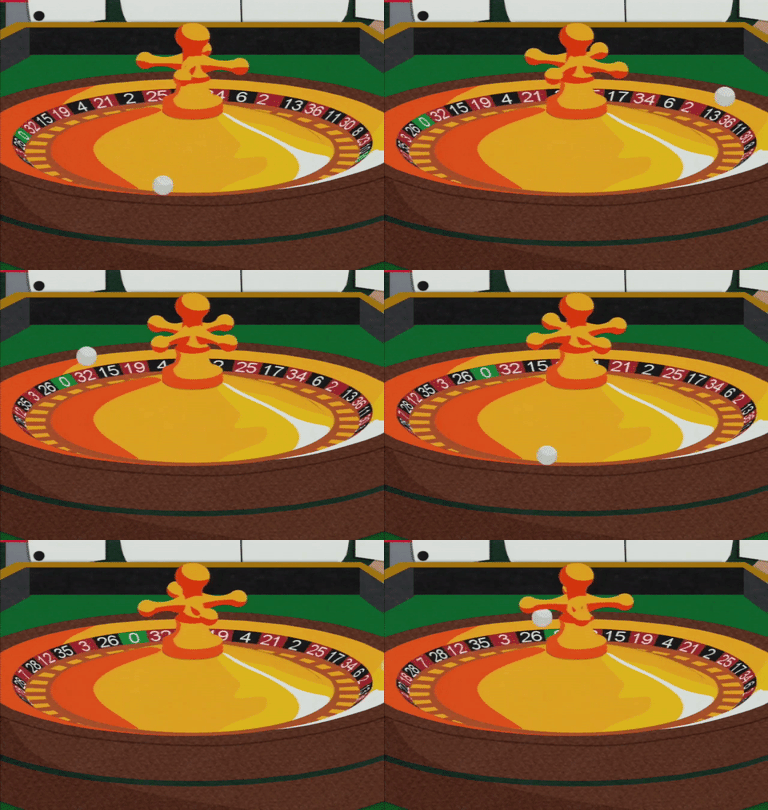
In a virtual casino game, the outcome of each game is dependent on the data produced by a pseudorandom number generator (PRNG). This determines the order of the cards in card games, the outcome of a dice throw, or the results produced by the spinning of a slot machine or roulette wheel. PRNGs use a set of mathematical instructions known as an algorithm to generate a long stream of numbers that give the impression of true randomness. While this is not the same as true random number generation (computers are incapable of this without an external input source), it provides results that satisfy all but the most stringent requirements for true randomness.
When implemented correctly, a PRNG algorithm such as the Mersenne Twister will ensure that the games are both fair and unpredictable. However, the player ultimately has to trust that the software has not been rigged to increase the house edge, as its inner workings are invisible to the user. Properly regulated online casinos are audited externally by independent regulators such as eCOGRA to ensure that their win percentages are in line with the stated odds, and this can provide a degree of assurance to the player that the games are fair, assuming the player trusts the regulator.
In a live casino game, a human dealer runs the game in real time from a casino gaming table, which can be seen via a live streaming video link. Players can make betting decisions via a console on their computer screen, and can communicate with the dealer using a text chat function.
The results of the physical transactions by the dealer, such as the outcome of the roulette wheel spin or the dealing of cards, are translated into data that can be utilized by the software by means of optical character recognition (OCR) technology. This enables the player to interact with the game in much the same way as they would with a virtual casino game, except for the fact that the results are determined by real-life actions rather than automated processes.
These games are a lot more expensive for websites to host than virtual games, as they involve a heavier investment in technology and staffing. A live casino studio typically employs one or more cameramen, several croupiers running the various games, an IT manager to ensure that any technical hitches are dealt with swiftly, and a pit boss that acts as an adjudicator in case of disputes between players and croupiers.
In most cases, this requires at least a three room setup, comprising a live studio, a server/software room, and an analyst’s room. The configuration of these rooms varies from casino to casino, with some having several gaming tables in one room, and some having a single table in each room.
The high running costs involved with operating live dealer games is the reason why online casinos only tend to offer a handful of the most popular games in this format, such as roulette, blackjack, sic bo, and baccarat. In comparison, the running costs associated with virtual games are very low, and it is not uncommon for online casinos to offer hundreds of different virtual casino games to players on their site.
Online casinos vary in their approach to the hosting of live games, with some providing live games via their own television channel, and others offering the games exclusively via their website. In the case of televised games, players can often use their mobile phone or television remote controls to place bets instead of doing so via a computer connected to the internet.